CIDP Document

Garissa County Integrated Development Plan 2023-2027

This document summarizes the Third Garissa County Integrated Development Plan (CIDP) for 2023-2027. It outlines the county's strategic roadmap for economic recovery, basic service improvements, climate change adaptation, and socio-economic transformation.

Garissa County county visual
Garissa County 2023-2027

The Third Garissa County Integrated Development Plan (2023-2027) guides economic recovery, basic service improvements, climate change adaptation, and socio-economic transformation.

Overview

This plan aims for a prosperous and cohesive Garissa County with a high quality of life, guided by democratic and equitable development principles. It addresses multifaceted challenges by aligning with national and international development agendas, including Kenya Vision 2030 and the SDGs, through a participatory process involving all 30 wards.

Development Priorities

  • Enhance economic recovery and growth.
  • Improve accessibility and quality of basic services.
  • Mitigate the impacts of climate change.
  • Foster people-responsive socio-economic transformation.
  • Strengthen health services and healthcare access.
  • Boost the agricultural and livestock economy.
  • Promote trade, investment, and enterprise.
  • Develop and maintain essential infrastructure.

Priority Sectors

  • Finance and Economic Planning
  • Health Services
  • Agriculture, Livestock, and Pastoral Economy
  • Water, Environment, Energy, Climate Change & Natural Resources
  • Trade, Investment and Enterprise Development
  • Roads, Transport, Public Works, and Housing
  • Gender, Social Services, Culture, Youth and Sports
  • Education, Information, and ICT

Key Challenges

  • Arid climate conditions causing droughts and floods.
  • High poverty and food insecurity.
  • Limited access to essential services in remote areas.
  • Inadequate infrastructure (water, transport, energy).
  • Economic vulnerability due to high dependency on livestock.
  • Socio-cultural barriers affecting education access.
  • Strain on resources from a large refugee population.
  • Low investment and limited economic diversification.
  • Environmental degradation and resource management issues.
  • High youth unemployment.

Implementation Issues

  • Limited financial resources.
  • County administration capacity constraints.
  • Coordination challenges among departments and partners.
  • Logistical difficulties in reaching remote areas.
  • Need for enhanced public participation.
  • Efficient resource mobilization and management.
  • Security concerns in specific areas.

Plan Structure

Chapter One: County Overview

Describes Garissa County's location, climate, administrative units, demographics, human development, and poverty.

Chapter Two: Performance Review

Reviews the implementation of the previous CIDP, analyzing revenue, expenditure, sector performance, challenges, and lessons learned.

Chapter Three: Spatial Development Framework

Presents strategies to guide spatial planning policy and address spatial challenges within the county.

Chapter 4: Development Priorities, Strategies and Programmes

Details development priorities, strategies, programs, and flagship projects aligned with national and international agendas.

Chapter Five: Implementation Framework

Outlines the institutional structure, resource mobilization, asset management, and risk management for plan implementation.

Chapter Six: Monitoring, Evaluation and Learning

Describes the framework for monitoring, evaluation, and learning, including indicators, data collection, reporting, and citizen engagement.

County Profile

Garissa County is in Kenya's North-Eastern region, covering 44,753 Km², bordering Somalia, Lamu, Tana River, Isiolo, and Wajir Counties.

The county's population was projected at 905,087 in 2022 and is expected to reach 1,012,920 by 2027, with an annual growth rate of approximately 3.5%.

Specific poverty statistics are not detailed in the provided text, though a 'Poverty Profile' is mentioned as a section within the plan.

Important Statistics

IndicatorValueNote
Total Area44,753 Km²Area of Garissa County.
Projected Population (2022)905,087Projected population for Garissa County.
Projected Population (2027)1,012,920Projected population for Garissa County.
Annual Population Growthapprox. 3.5%Projected annual population growth rate for Garissa County.
Dominant LivelihoodLivestock productionOver 90 percent of inhabitants derive livelihood from livestock.
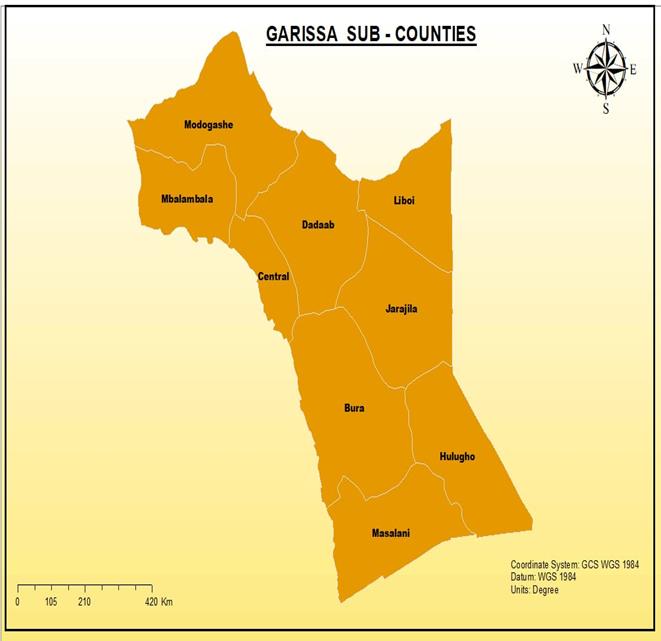
Number of Sub-Counties10Operational sub-counties in Garissa County.

Official PDF

Open the source document to verify sections and references directly from the official PDF.

Frequently Asked Questions

What is the primary objective of the Garissa CIDP 2023-2027?

The plan aims to achieve a competitive, prosperous, and cohesive county with a high quality of life by focusing on economic recovery, basic service improvements, climate change adaptation, and socio-economic transformation.

What are the main development priorities for Garissa County?

Key priorities include enhancing economic recovery, improving basic services, addressing climate change, fostering socio-economic transformation, strengthening health services, boosting the agricultural economy, promoting trade and investment, and developing infrastructure.

What are the significant challenges facing Garissa County?

Major challenges include arid climate conditions, high poverty, limited access to services, inadequate infrastructure, economic vulnerability, socio-cultural barriers, a large refugee population, low investment, environmental issues, and youth unemployment.

How was the Garissa CIDP 2023-2027 developed?

The plan was developed through a participatory process involving stakeholders from all 30 wards of Garissa County.

What is the projected population of Garissa County by 2027?

The projected population for Garissa County by 2027 is 1,012,920.

What is the main source of livelihood in Garissa County?

Livestock production is the dominant economic activity, supporting over 90 percent of the inhabitants.